
The Instagram Problem with Space Photography
Every time NASA releases an image from the Hubble Space Telescope or the James Webb Space Telescope, my social media feeds light up with comments like “How can they photograph something so far away?” or “This looks too perfect to be real.” I get it. These images are genuinely beautiful, and our brains struggle to process how we can capture crystal-clear photos of objects trillions of miles away when my phone camera can barely focus on my coffee cup in dim lighting.
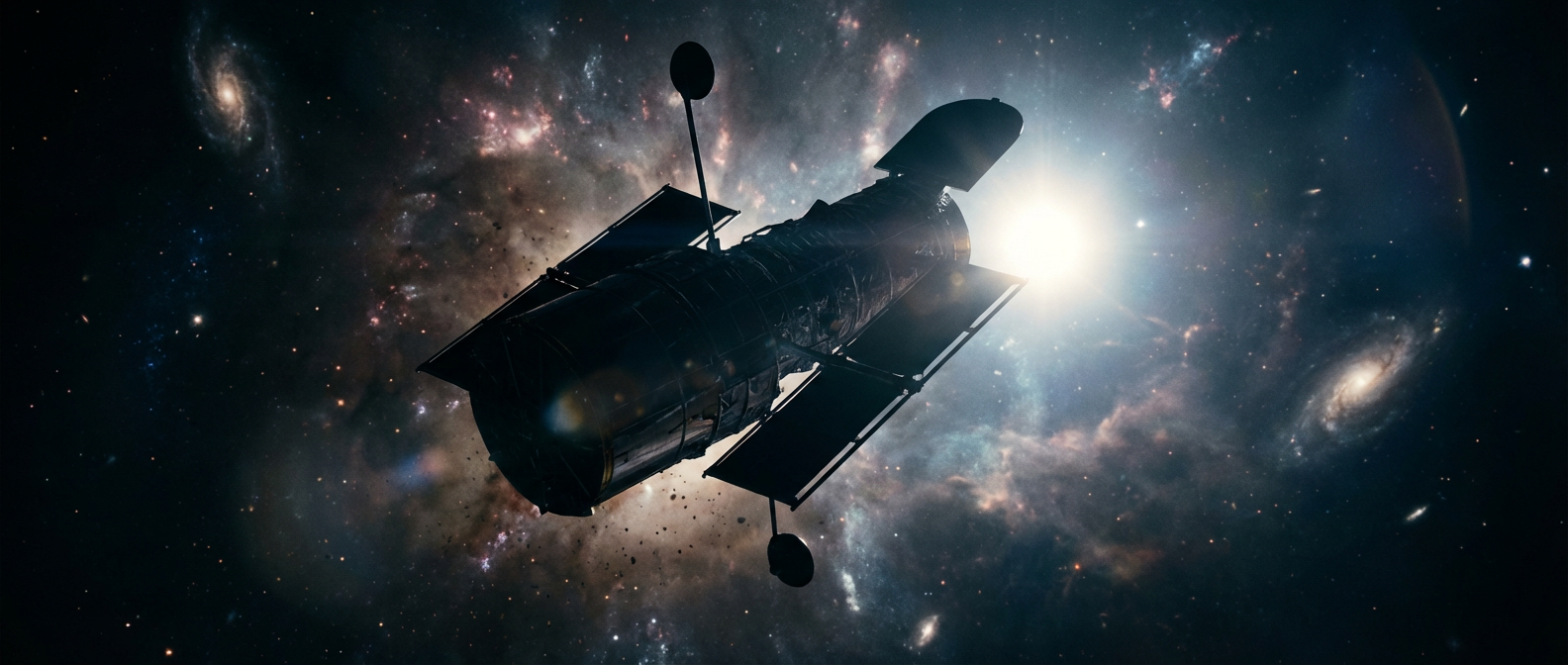
But here’s what keeps me up at night reading technical papers: what we call “photographs” from space telescopes aren’t really photographs in the way most people understand them. They’re sophisticated reconstructions built from data that often has nothing to do with visible light. The Pillars of Creation image that probably graces someone’s desktop wallpaper right now? That shot combines infrared wavelengths our eyes can’t see, translated into colors our brains can process.
This misconception matters because it affects how people interpret space discoveries. When someone sees a “photo” of an exoplanet and asks why we can’t see cities or continents on it, they’re assuming that space telescopes work like really powerful cameras. Understanding what these instruments actually detect changes everything about how we evaluate their remarkable findings.

What Space Telescopes Really Detect
Space telescopes are basically sophisticated light buckets with incredibly sensitive detectors. But “light” here means the entire electromagnetic spectrum, not just the narrow band our eyes evolved to see. The James Webb Space Telescope primarily operates in infrared wavelengths, detecting heat signatures from objects that formed when the universe was less than a billion years old. Hubble captures everything from ultraviolet to near-infrared. X-ray telescopes like Chandra pick up high-energy radiation from violent cosmic events.
When astronomers “observe” a distant galaxy, they’re really collecting photons that have traveled for billions of years, analyzing their wavelengths to determine the object’s composition, temperature, motion, and age. It’s like being a detective who solves crimes by examining dust particles under a microscope, except the dust particles are individual photons and the crime scene is the entire observable universe.
The data arrives as numbers, not pictures. Imagine opening a spreadsheet with millions of cells, each containing the intensity of light detected at specific wavelengths and positions. The “images” we see are created when astronomers assign colors to different wavelengths and intensities, building up a visual representation of invisible information. It’s closer to medical imaging than to photography.
The Art and Science of False Color Imaging
The term “false color” makes people suspicious, as if astronomers are deliberately misleading the public. I’ve seen conspiracy theories bloom from this misunderstanding. But false color imaging is simply a translation tool, like converting a song into sheet music or turning temperature data into a weather map. The colors are “false” in that they don’t represent what our eyes would see, but they’re absolutely real in terms of the scientific information they convey.
Consider the famous images of nebulae in vivid reds, blues, and greens. These colors often represent different elements: hydrogen might be mapped to red, oxygen to green, and sulfur to blue. This isn’t artistic license. It’s a way to visualize chemical composition across vast clouds of gas and dust. An image showing regions of active star formation in bright blue and older stellar populations in red isn’t making things up. It’s revealing real differences in stellar ages that happen to be invisible to human eyes.
The Webb telescope’s infrared capabilities have changed this process completely. Its images of star-forming regions pierce through cosmic dust that blocks visible light, revealing stellar nurseries in unprecedented detail. When you see those amber and orange tones in Webb images, you’re looking at a translation of infrared wavelengths that reveal temperature differences and dust composition. The galaxy appears golden not because it’s actually gold-colored, but because Webb is showing us thermal information that tells a story about stellar evolution and galactic structure.
Resolution Isn’t What You Think It Is
Another persistent misconception revolves around resolution and distance. People assume that if we can photograph distant galaxies in detail, we should be able to see much smaller, closer objects with incredible clarity. This thinking leads to questions like “Why can’t we see the Apollo landing sites with Hubble?” or “If exoplanets are just dots, how do we know so much about them?”
Space telescope resolution depends on the size of the telescope’s primary mirror and the wavelength of light being collected. Hubble’s 2.4-meter mirror provides incredible resolution for objects that emit or reflect enough light, but even Hubble can’t resolve surface features on planets beyond our solar system. The nearest exoplanet, Proxima Centauri b, appears as less than a single pixel even to our most powerful telescopes.
Yet we know Proxima Centauri b is roughly Earth-sized and orbits in its star’s habitable zone. We know this not from direct imaging, but from detecting tiny brightness changes as the planet transits its star and measuring gravitational wobbles in the star’s position. It’s the difference between seeing something and detecting its effects. We’ve never “seen” dark matter either, but its gravitational influence on visible matter makes its existence undeniable.
Why These Distinctions Matter for Understanding Discovery
Getting telescope observations right matters because it changes how we evaluate scientific claims. When researchers announce the detection of water vapor in an exoplanet’s atmosphere, they’re not claiming to have photographed clouds. They’re analyzing the spectrum of starlight filtered through that atmosphere, identifying absorption lines that match water’s unique spectral signature. It’s indirect evidence, but it’s incredibly robust when multiple independent observations confirm the finding.
Understanding these methods also helps distinguish between preliminary results and confirmed discoveries. Early reports often describe “candidate” exoplanets or “possible” detections because the data requires careful analysis and verification. The recent excitement over biosignature gases in exoplanet atmospheres isn’t based on seeing green landscapes from space. It’s based on detecting molecular signatures that, on Earth, are associated with biological processes.
This knowledge transforms how we read space science news. Instead of wondering whether images are “real,” we can focus on what the data actually reveals about cosmic phenomena. We can appreciate both the remarkable engineering that makes these observations possible and the careful analysis required to extract meaningful science from faint signals across impossible distances.
The next time you see a spectacular space telescope image, remember that you’re looking at a translation of invisible information into visual form. It’s no less real for being translated, and understanding that translation process makes the underlying discoveries even more remarkable. What keeps me texting friends at 3am isn’t just the pretty pictures. It’s the realization that we’re decoding messages written in light by the universe itself.