Beyond the Test Tube: When Biology Becomes Technology
Picture this: instead of massive steel refineries belching smoke into the sky, imagine sleek bioreactors humming quietly as engineered microbes churn out everything from jet fuel to life-saving medicines. This isn’t science fiction anymore. It’s synthetic biology, and it’s completely changing how we think about manufacturing, medicine, and even what it means to be alive.
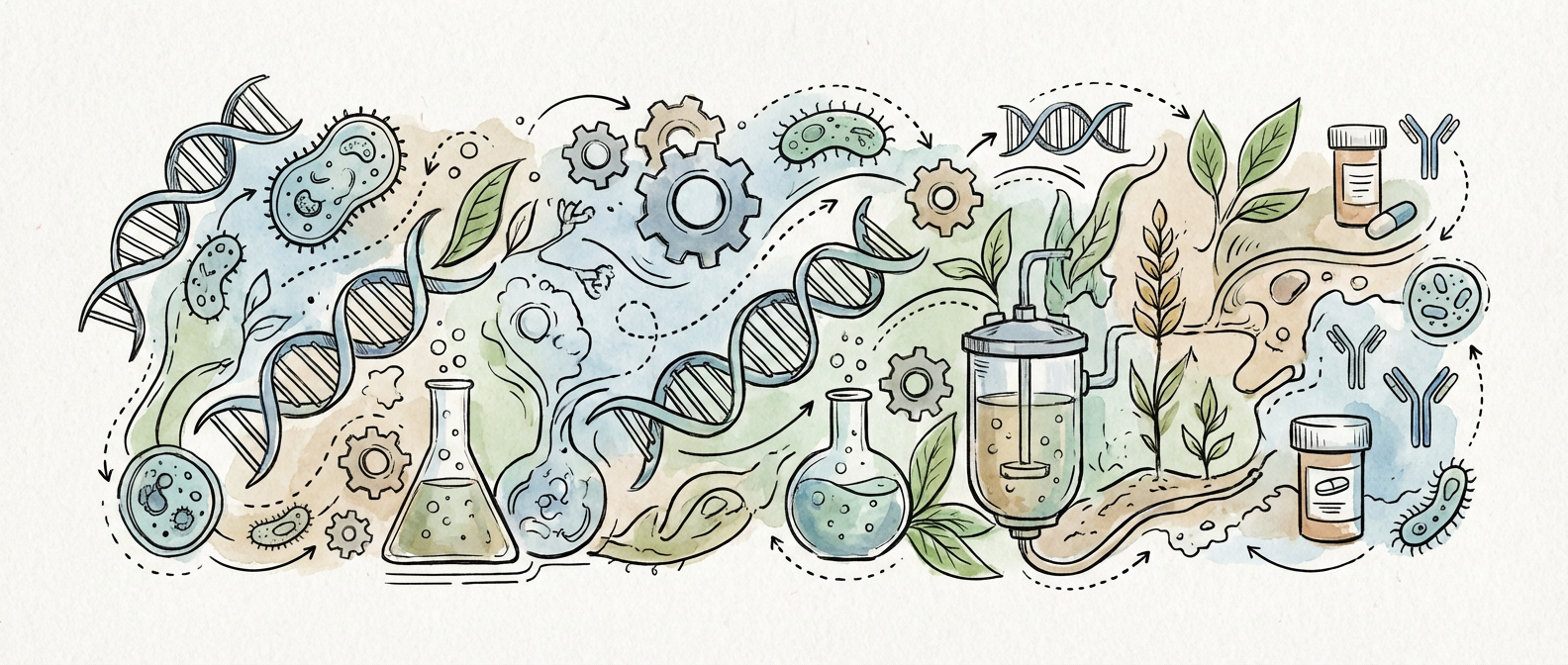
At its core, synthetic biology treats living cells like programmable machines. Researchers design genetic circuits the way electrical engineers design computer chips, inserting new DNA sequences that give organisms entirely new capabilities. The field has exploded from academic curiosity to billion-dollar industry in just two decades. Plummeting costs of DNA synthesis and increasingly powerful genetic engineering tools made it possible.
What makes this moment particularly exciting is how synthetic biology bridges the gap between digital information and physical reality. When scientists at Ginkgo Bioworks program bacteria to produce a specific fragrance molecule, they’re essentially writing code that gets executed by living cells. The organism becomes both the factory and the worker, self-replicating and self-maintaining in ways no traditional manufacturing system could match.

The Medicine Makers: Biologics and Beyond
The pharmaceutical applications alone are mind-blowing. Consider Novartis’s CAR-T cell therapy, where doctors extract a patient’s immune cells, genetically reprogram them to hunt cancer more effectively, then infuse them back into the body. It’s personalized medicine taken to its logical extreme, where the treatment is literally tailored at the genetic level for each individual patient.
But the real game-changer might be in drug manufacturing itself. Traditional pharmaceutical production relies on complex chemical synthesis, often requiring harsh solvents and generating substantial waste. Synthetic biology offers an alternative: engineer yeast or bacteria to produce the same compounds through fermentation. Sanofi has already implemented this approach for artemisinin, the key component of malaria drugs, using genetically modified yeast to ensure stable supply of this medicine.
The COVID-19 pandemic revealed synthetic biology’s potential for rapid response. While traditional vaccine development might take years, companies like Moderna used synthetic biology principles to design their mRNA vaccine in just two days after receiving the virus’s genetic sequence. The remaining time was spent on testing and manufacturing scale-up, not fundamental design work.
Looking ahead, researchers are pushing even further boundaries. Teams are engineering bacteria to produce complex proteins that could treat rare genetic diseases, while others work on “living therapeutics” where beneficial microbes are designed to colonize the gut and continuously produce medicines exactly where they’re needed.
Industrial Evolution: From Petrochemicals to Living Factories
The industrial applications stretch far beyond medicine. Companies like Zymergen and Gensyn are engineering microorganisms to produce chemicals traditionally derived from petroleum. Need polyester for clothing? Engineer bacteria to produce the precursor molecules. Want sustainable jet fuel? Modify algae to secrete hydrocarbons that can be refined into aviation fuel.
Biological manufacturing has an inherent elegance when it comes to sustainability. Unlike traditional chemical processes that require high temperatures and pressures, biological systems operate at room temperature using renewable feedstocks like sugar or plant waste. When Unilever partnered with synthetic biology companies to produce cleaning agents using engineered microbes, they weren’t just finding a new manufacturing method, they were completely reducing the environmental footprint of household products.
The textile industry provides another compelling example. Bolt Threads has engineered bacteria to produce spider silk proteins, creating materials with the strength of steel and the flexibility of rubber. Meanwhile, Modern Meadow uses synthetic biology to grow leather-like materials without any animals involved. These aren’t just alternatives to existing products. They’re materials with properties that couldn’t be achieved through traditional manufacturing.
The Human Element: Collaboration and Ethical Frontiers
Behind these technological marvels are researchers who often blur the lines between traditional disciplines. Take Christina Agapakis, whose background spans molecular biology, art, and design. As Creative Director at Ginkgo Bioworks, she represents how synthetic biology demands new kinds of collaboration between scientists, engineers, and even artists who help envision how biotechnology might integrate into society.
The field’s rapid advancement has also sparked important ethical discussions. When Jennifer Doudna, co-inventor of CRISPR gene editing, calls for responsible development of genetic technologies, she’s reflecting a broader awareness within the synthetic biology community about their responsibility to society. Researchers aren’t just asking “can we do this?” but “should we do this?” and “how do we ensure equitable access to these technologies?”
Academic institutions are responding by creating new interdisciplinary programs that combine technical training with ethics, policy, and social science. MIT’s Biological Engineering department, for instance, requires students to grapple with the societal implications of their work alongside the technical challenges. These programs recognize that the scientists designing tomorrow’s living technologies need to understand their broader impact on society.
The international nature of synthetic biology research also creates unique opportunities for global collaboration. When teams from different countries work together on projects like producing antimalarial drugs or developing sustainable biofuels, they’re not just sharing technical knowledge, they’re building networks that could help ensure these technologies benefit people worldwide rather than making existing inequalities worse.
The Living Future: Where Biology Meets Possibility
Perhaps the most exciting aspect of synthetic biology is how it’s still in its infancy. Current applications, impressive as they are, represent just the beginning of what’s possible when we treat biology as a design space rather than a constraint. Researchers are working on biological computers that could process information inside living cells, self-healing materials that repair themselves using biological processes, and even terraforming technologies that could help make other planets habitable.
The convergence of synthetic biology with other emerging technologies promises even more dramatic possibilities. Imagine combining engineered organisms with nanotechnology to create materials that adapt to their environment, or pairing biological sensors with artificial intelligence to monitor ecosystem health in real-time. These aren’t distant dreams. They’re active areas of research with early proof-of-concept demonstrations already published.
What strikes me most about conversations with synthetic biologists is their infectious optimism balanced with scientific rigor. They’re acutely aware of the challenges ahead, from technical hurdles in engineering complex biological systems to regulatory frameworks that need to evolve alongside the technology. Yet there’s a real sense that we’re witnessing the early stages of a transformation as significant as the digital revolution.
The next decade will likely bring synthetic biology applications we can barely imagine today. If you’re as fascinated by this intersection of life and technology as I am, I’d love to hear your thoughts on which applications excite or concern you most. The conversation about how we shape this biological future belongs to all of us, not just the scientists in the lab.