
When the Models Break Down
Picture this: you’re a glaciologist who has spent years perfecting computer models that predict how Antarctic ice will behave under climate change. These models account for temperature rises, ocean warming, wind patterns, and countless other variables. Then satellite data comes in showing a massive crack system that your models said shouldn’t exist for decades, if ever. That’s exactly what happened in December 2025 when researchers discovered a 47-kilometer crack network sprawling across the Thwaites Glacier like a spider web of impending collapse.
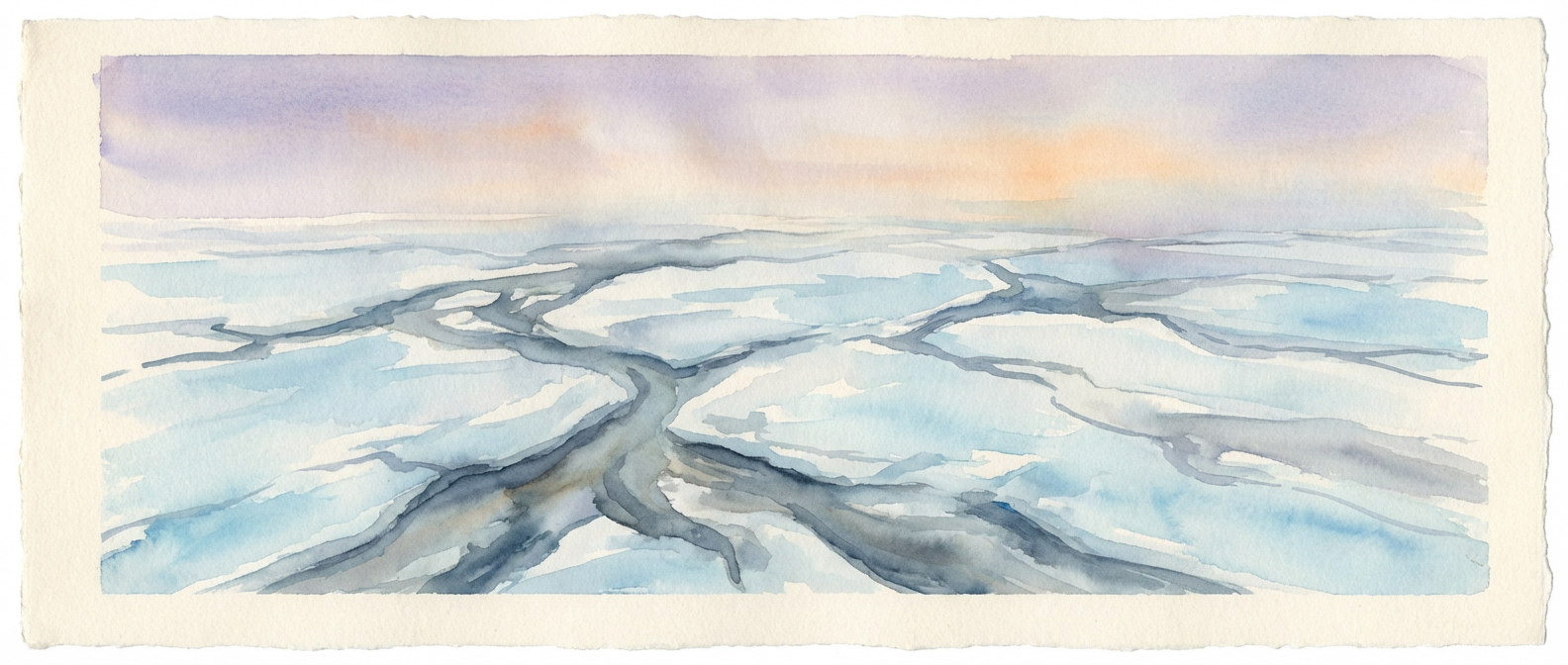
The Thwaites Glacier, often called the “Doomsday Glacier” for good reason, has been under intense scientific scrutiny for years. But this new crack pattern caught everyone off guard because it doesn’t follow the stress patterns that current ice sheet models predict. Instead of forming where computer simulations suggested the ice should break, these fissures are carving paths along geological features deep beneath the ice that we barely knew existed until recently.
What makes this discovery particularly unsettling is how it challenges our understanding of ice sheet dynamics. Climate models aren’t just academic exercises. They’re the foundation for coastal planning, climate policy, and literally trillions of dollars in infrastructure decisions worldwide. When the models miss something this significant, it forces us to question what else we might be getting wrong.
The Underground Geography That Changes Everything
The key to understanding these unexpected cracks lies beneath nearly two miles of ice, in the rocky landscape that the ROSETTA-Ice project has been painstakingly mapping. This research initiative has revealed that the bedrock beneath Antarctic ice sheets is far more complex than previously imagined, riddled with valleys, ridges, and fault lines that create a hidden topographical maze.
The newly discovered crack system is following these underground fault lines with startling precision, suggesting that the geological foundation beneath the ice plays a much larger role in ice sheet behavior than our models account for. Think of it like this: imagine trying to predict how a piece of glass will shatter without knowing about the microscopic stress lines already embedded within it. That’s what we’ve been doing with Antarctic ice sheets.
These geological features act like predetermined breaking points. They create pathways of weakness that allow cracks to spread much faster and farther than smooth bedrock would permit. The implications are staggering because it means that ice sheet collapse could follow geological roadmaps we’re only beginning to understand, rather than the relatively predictable patterns our current models assume.
The Acceleration That Has Scientists Scrambling
The numbers coming from NASA ICESat mission data paint a picture of acceleration that’s frankly terrifying. Ice loss from the Thwaites system jumped from 76 billion tons in 2024 to 89 billion tons in 2025. That’s enough water to fill Lake Erie in a single year. But the raw tonnage isn’t even the most concerning part. It’s the rate of change that has researchers working overtime to understand what’s happening.
Dr. Catherine Walker’s measurements show that ice velocity in the affected regions has increased by 340% compared to 2020 baseline measurements. Picture a river suddenly flowing more than four times faster than normal. That’s not a gradual change. That’s a shift in the system’s behavior that suggests we’ve crossed some kind of threshold.
This acceleration appears to be driven by a feedback loop where the new crack system allows more warm ocean water to penetrate beneath the ice sheet. This lubricates the base and allows the ice to slide toward the ocean even faster. Each crack that forms makes the next crack more likely, creating a cascading effect that our models struggle to capture because they weren’t designed to handle such rapid, non-linear changes.
Rewriting the Timeline for Rising Seas
The discovery triggered an emergency briefing by the IPCC in February 2026, something that doesn’t happen unless the implications are genuinely urgent. The result was a revision of sea level rise projections upward by 15-23 centimeters by 2100. That might not sound like much, but those extra inches represent millions of homes at risk. Entire island nations could become uninhabitable. Coastal cities face infrastructure challenges they weren’t planning for.
What’s particularly sobering about these revised projections is that they’re based on what we can observe and model right now. The IPCC climate reports are conservative by nature because they only include changes that scientists can quantify with high confidence. The fact that they felt compelled to issue emergency revisions suggests that the evidence for accelerated ice loss has become undeniable.
But here’s the thing that keeps me awake at night reading these papers: these new projections still might be underestimating the problem. If our models missed this crack pattern entirely, what other surprises might be lurking in the Antarctic ice? The possibility of marine ice sheet instability—where large sections of ice sheet collapse in a matter of decades rather than centuries—suddenly seems less like a worst-case scenario and more like a plausible outcome we need to prepare for.
The Race to Understand What We’re Missing
The scientific response to this discovery has been swift and intense. Research teams are scrambling to incorporate geological fault data into ice sheet models, deploy new sensor networks across Antarctic ice sheets, and develop more sophisticated monitoring systems that can detect these kinds of changes in real-time rather than months after they occur.
The challenge is enormous because it requires bridging multiple scientific disciplines that haven’t always worked closely together. Glaciologists need to collaborate with geologists, oceanographers with seismologists, and computer modelers with field researchers in ways that push the boundaries of how Antarctic science is traditionally conducted. It’s like suddenly realizing you need to solve a puzzle with pieces from several different boxes.
What gives me hope is the sheer determination I see in the research community to figure this out. Scientists are sharing data faster than ever. Computational resources are being redirected toward Antarctic modeling. New international collaborations are forming with unprecedented speed. The urgency is palpable, and that urgency is driving innovations in everything from satellite monitoring to machine learning applications for ice sheet prediction.
This isn’t just an academic exercise anymore. It’s a race against time to understand the systems that will determine the fate of every coastal city on Earth. And honestly, that makes it some of the most important and exciting science happening anywhere on the planet right now. If you want to follow along with this unfolding story, I’ll be tracking the latest research and sharing updates as this remarkable scientific detective story continues.