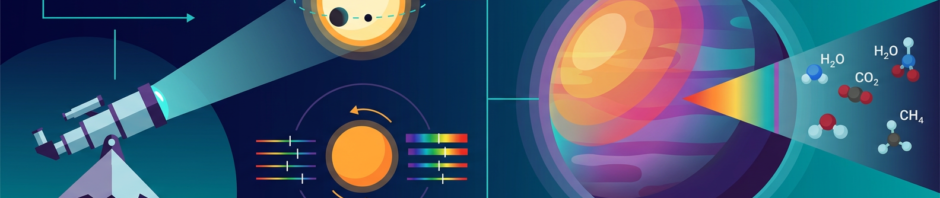
When Everything is Unimaginably Far Away
Picture this: you’re standing in New York City, trying to spot a firefly in Los Angeles. Not just any firefly, but one that’s orbiting a blazing searchlight so bright it drowns out everything around it. Oh, and you have to do this while both you and the firefly are hurtling through space at thousands of miles per hour. Welcome to exoplanet detection, where the scale of what we’re attempting should be physically impossible, yet somehow we’re pulling it off.
The nearest star to our Sun, Proxima Centauri, sits about 4.2 light-years away. If you could drive there at highway speeds without stopping, the trip would take roughly 30 million years. And we’re not just trying to detect stars at these distances. We’re hunting for planets orbiting those stars, objects that are typically millions of times dimmer than their host stars and separated from them by distances smaller than the width of a human hair when viewed from Earth.
Yet in the past three decades, we’ve confirmed the existence of over 5,000 exoplanets. The first confirmed detection around a main-sequence star came in 1995 with 51 Pegasi b, a discovery that seemed so improbable at the time that many astronomers initially questioned the results. Today, we’re not just finding these worlds. We’re studying their atmospheres, measuring their densities, and even beginning to understand their weather patterns.
The Transit Method: Cosmic Hide and Seek
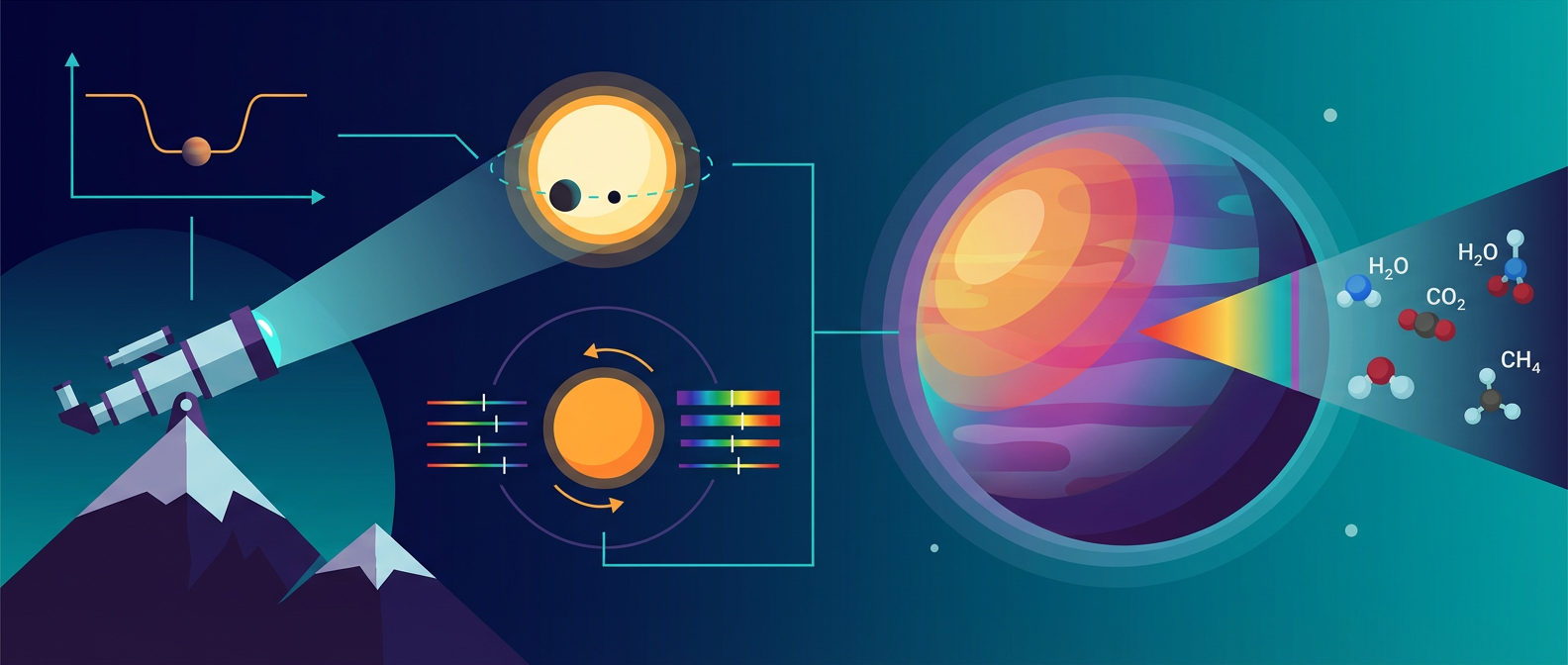
The most successful technique for finding exoplanets exploits a beautiful geometric coincidence. When a planet’s orbit happens to align just right from our perspective, it passes directly in front of its star once per orbit, causing a tiny but measurable dip in the star’s brightness. This transit method sounds simple in principle, but the scales involved are mind-boggling.
Consider Earth transiting the Sun as viewed from a distant star. Our planet would block approximately 0.008% of the Sun’s light. That’s like trying to measure the difference between a 10,000-watt spotlight and a 9,999.2-watt spotlight from across a football stadium. For smaller planets like Mars, we’re talking about detecting brightness changes of just 0.003%. The precision required is so extreme that ground-based telescopes, dealing with atmospheric turbulence and weather, simply cannot achieve it reliably.
This is where space-based missions like Kepler and TESS come in. Kepler monitored over 150,000 stars simultaneously for four years, measuring brightness changes with a precision of about 20 parts per million. To achieve this level of stability, the spacecraft had to maintain its pointing accuracy to within a few thousandths of a degree while traveling through space at 67,000 miles per hour. It’s an engineering achievement that turns theoretical impossibility into observational reality.
Radial Velocity: Measuring the Unmeasurable Wobble
The other major detection method relies on an even more subtle effect. As a planet orbits its star, gravity works both ways. The star tugs on the planet, but the planet also tugs back on the star, causing it to wobble ever so slightly. We can detect this wobble by measuring tiny shifts in the star’s spectrum using the Doppler effect, the same principle that changes the pitch of an ambulance siren as it passes by.
The scale of these stellar wobbles defies intuition. Jupiter, the most massive planet in our solar system, causes the Sun to move at a maximum speed of about 12.4 meters per second. That’s roughly the speed of a recreational cyclist. Earth’s gravitational influence on the Sun produces a wobble of just 9 centimeters per second. We’re measuring velocity changes smaller than the speed at which grass grows, from objects that are trillions of miles away.
Modern spectrographs like HARPS and ESPRESSO can measure stellar velocities to precisions approaching 10 centimeters per second. This means we’re detecting motion slower than a leisurely walk, using light that has traveled for years or decades to reach us. The fact that we can extract such precise information from ancient photons is honestly mind-blowing.
Direct Imaging: The Ultimate Challenge
Perhaps the most ambitious approach to exoplanet detection involves direct imaging, literally taking pictures of planets around other stars. The scale problem here becomes almost comical in its extremes. A typical exoplanet is roughly 10 billion times fainter than its host star. In our solar system analogy, this would be like trying to photograph a grain of sand next to a lighthouse beam from 25 miles away.
The challenge goes beyond simple brightness ratios. Angular separation matters too. Most known exoplanets orbit within a few astronomical units of their stars. From the nearest star systems, this translates to angular separations measured in milliarcseconds. One milliarcsecond is roughly equivalent to the apparent size of a dime viewed from a distance of 2,000 miles. We’re essentially trying to resolve details smaller than anything the human eye could distinguish, even with perfect vision.
Current direct imaging successes focus on young, massive planets orbiting relatively far from very nearby stars. HR 8799, located about 129 light-years away, has four directly imaged planets, but these are all Jupiter-mass objects orbiting 15-70 AU from their star. Even with next-generation telescopes like the James Webb Space Telescope and upcoming Extremely Large Telescopes, imaging Earth-sized planets in habitable zones remains at the very edge of possibility.
Beyond Detection: The Characterization Revolution
Finding exoplanets was just the beginning. The real excitement comes from characterization, extracting detailed information about these distant worlds. Transit spectroscopy allows us to analyze exoplanet atmospheres by studying how starlight filters through them during transits. We’ve detected water vapor, carbon dioxide, and even clouds on worlds hundreds of light-years away.
The precision required for atmospheric characterization pushes our scale problems into new territory. We’re measuring absorption features that represent tiny fractions of already tiny brightness changes. A typical atmospheric signal might be 10-50 parts per million on top of a transit depth of 1% or less. This is like detecting the shadow cast by a human hair on a lighthouse beam from several miles away, then analyzing the color of that shadow to determine what the hair is made of.
Recent results from JWST have completely changed exoplanet atmospheric science. The telescope has detected water vapor in the atmosphere of WASP-96b, carbon dioxide around WASP-39b, and even mapped temperature variations across the day and night sides of several hot Jupiters. Each observation requires thousands of hours of planning, observation, and analysis to extract meaningful signals from data that shouldn’t contain enough information to tell us anything useful.
What strikes me most about exoplanet science is how it constantly redefines what we consider possible. Every successful detection pushes the boundaries of measurement precision, data analysis techniques, and our understanding of planetary systems. We’re living through a golden age of exoplanet discovery, and each new world we find reminds us that the universe is far stranger, more diverse, and more wonderful than we ever imagined. The scales involved may be incomprehensible, but our ability to work at those scales keeps getting better, bringing us closer to answering one of humanity’s most profound questions: are we alone?