The Quantum Advantage Nobody Talks About
While everyone fixates on when quantum computers will crack RSA encryption or revolutionize drug discovery, the most interesting breakthroughs happening right now are far more subtle. IBM’s recent demonstration of their 1000-qubit Condor chip isn’t just about raw qubit count. It’s about something called “quantum volume” – a holistic measure that factors in error rates, connectivity, and gate fidelity. The jump from their 433-qubit Osprey to Condor represents a 2.5x improvement in quantum volume, not the expected 2.3x scaling you’d predict from qubit count alone.
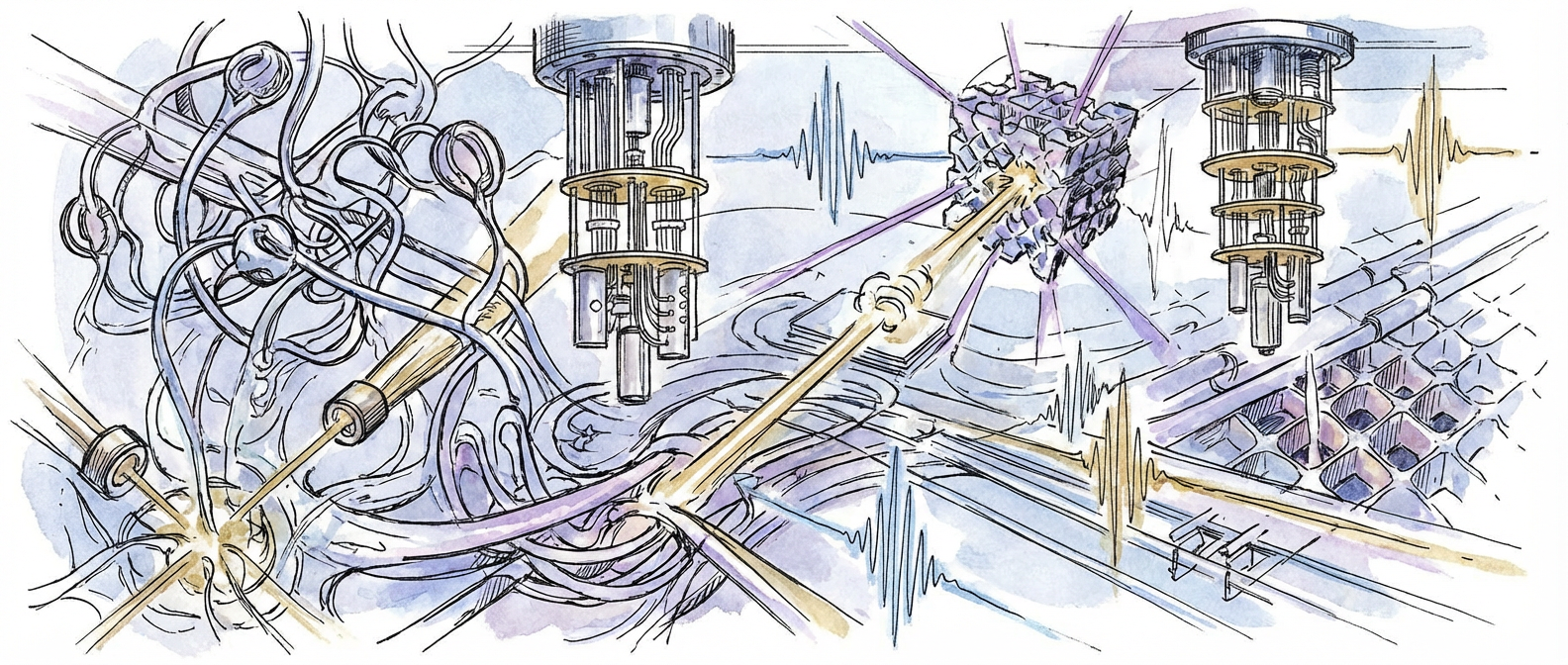
This matters because we’re entering a phase where quantum advantage doesn’t require millions of qubits. Google’s recent work on quantum error correction using their Willow chip shows logical error rates decreasing as they add more physical qubits, a milestone that reverses decades of increasing error accumulation. We’re not just building bigger quantum computers anymore. We’re building better ones.
But here’s what gets me excited at 2am when I’m deep in the arxiv papers: the implications ripple out in ways that reshape entire technological fields. When quantum volume improvements compound annually at current rates, we hit practical advantage for specific problems much sooner than the conservative 2035 estimates suggest.

The Materials Revolution Nobody Saw Coming
The real breakthrough isn’t happening in the quantum processors themselves. It’s in the materials engineering that makes them possible. Superconducting qubits require operating temperatures of 15 millikelvin, colder than deep space. Recent advances in dilution refrigerator technology and vibration isolation have reduced decoherence times from microseconds to milliseconds in some systems.
Intel’s silicon spin qubits represent a completely different approach that could operate at 1 kelvin. Still incredibly cold, but achievable with much simpler refrigeration. Their recent demonstration of single-qubit gate fidelities above 99.5% in silicon suggests we might see quantum processors manufactured in existing semiconductor fabs within five years. This isn’t just about cost reduction. It’s about leveraging the entire semiconductor supply chain that took decades to perfect.
Photonic quantum computing sidesteps the temperature problem entirely. PsiQuantum’s recent progress toward million-photon experiments using silicon photonics suggests room-temperature quantum computers aren’t fantasy. The trade-off is complexity – you need thousands of components to create a single logical qubit – but the manufacturing processes already exist.
What happens when these approaches converge? We get specialized quantum processors optimized for specific problem classes, integrated into classical computing systems the same way GPUs transformed machine learning. The question isn’t whether this will happen, but how quickly different industries will adapt.
The Connectivity Problem That Changes Everything
Most coverage of quantum computing ignores a critical limitation: qubit connectivity. Current systems connect each qubit to only a few neighbors, creating bottlenecks that require extensive quantum error correction overhead. Atom Computing’s recent demonstration of 1180 neutral atom qubits achieves something remarkable – every qubit can interact with every other qubit through reconfigurable optical tweezers.
This isn’t just an incremental improvement. All-to-all connectivity reduces the circuit depth required for complex algorithms by orders of magnitude. Algorithms that need hundreds of error-corrected logical qubits might run on dozens of physical qubits with full connectivity. We’re potentially looking at useful quantum advantage years earlier than current roadmaps suggest.
The second-order effects ripple through algorithm development. Quantum approximate optimization algorithms (QAOA) that seemed impractical because of connectivity constraints become viable for near-term applications. Portfolio optimization, supply chain logistics, and protein folding simulations that required fault-tolerant quantum computers might run on noisy intermediate-scale quantum (NISQ) devices with better connectivity.
But here’s where I pump the brakes on my own enthusiasm. Neutral atom systems still face significant challenges with gate fidelities and operational complexity. The path from laboratory demonstration to commercial deployment involves engineering challenges that could take years to solve. Still, the proof of concept reshapes what we consider possible in the near term.
Error Correction’s Unexpected Timeline
Quantum error correction was supposed to be the distant future, something requiring millions of physical qubits to create thousands of logical ones. Google’s Willow chip demonstrates logical qubits with error rates below their constituent physical qubits, achieving what’s called “below threshold” operation. This milestone was expected around 2030, not 2024.
The implications ripple through every quantum computing timeline. Useful quantum algorithms require logical error rates around 10^-12 to 10^-15 for meaningful computation. If current error correction improvements continue, we reach these levels with hundreds of thousands of physical qubits, not millions. The timeline for useful quantum computing just compressed by roughly a decade.
Microsoft’s topological qubits approach this differently, promising inherently error-resistant quantum states. Their recent progress with Majorana zero modes suggests physical qubits that might not need extensive error correction. Combined with their quantum simulation successes modeling molecular hydrogen, we’re seeing converging evidence that multiple paths lead to the same destination.
The economic implications are staggering. Industries planning quantum-resistant cryptography migrations on 15-year timelines might need to accelerate. Pharmaceutical companies modeling quantum-assisted drug discovery for the 2040s should reconsider their R&D allocations. Financial institutions exploring quantum machine learning might find viable applications within this decade.
What This Actually Means for the Next Five Years
Let me be clear about what’s speculation versus what’s engineering reality. Fault-tolerant quantum computers running Shor’s algorithm against RSA-2048 remain years away, accelerating progress aside. The physics and engineering challenges are solved in principle, but implementation at scale requires advances we can’t schedule precisely.
However, quantum advantage for optimization problems, quantum machine learning, and materials simulation could arrive much sooner than expected. The combination of better error rates, improved connectivity, and novel algorithms creates a convergence point where useful quantum computing emerges gradually, then suddenly.
The companies preparing now – training quantum software engineers, developing quantum-classical hybrid algorithms, and establishing partnerships with quantum hardware providers – position themselves for advantage when this convergence accelerates. The organizations waiting for “fully mature” quantum computers might find themselves scrambling to catch up.
This is why I find myself reading quantum computing papers until the early morning hours, texting friends about breakthrough announcements, and trying to piece together the implications that ripple far beyond the immediate technical achievements. We’re watching the early stages of a computational revolution that will reshape how we solve humanity’s most complex challenges.
What aspects of these quantum hardware developments intrigue you most? Are you seeing implications I haven’t considered, or do you think I’m overestimating the timeline for practical impact? The conversation around quantum computing’s trajectory needs more voices from different perspectives. The implications are too important for any single viewpoint to capture completely.