
A Moment of Genuine Medical Triumph
I need to start by being transparent about what happened in early 2025, because it genuinely matters. A clinical trial published in the New England Journal of Medicine – Gene Therapy for Sickle Cell reported that 97% of trial participants with sickle cell disease achieved transfusion independence at their 12-month follow-up checkpoint. Read that number again. Ninety-seven percent. For a group of patients who have spent their lives managing a genetic disorder through regular blood transfusions, some since childhood, this is a fundamental reordering of what their disease means.

The therapy is BEAM-101, developed by Beam Therapeutics, using a particular flavor of CRISPR technology called base editing. I was awake at 3am reading the trial data when it landed in my inbox, and I’ve been thinking about it ever since. Not because the result surprised me — the science here is genuinely elegant — but because of the vast gulf between what works in a clinical trial and what your actual doctor can prescribe. That gulf is the real story here, and it’s not a happy one.
Why Base Editing Changes the CRISPR Equation
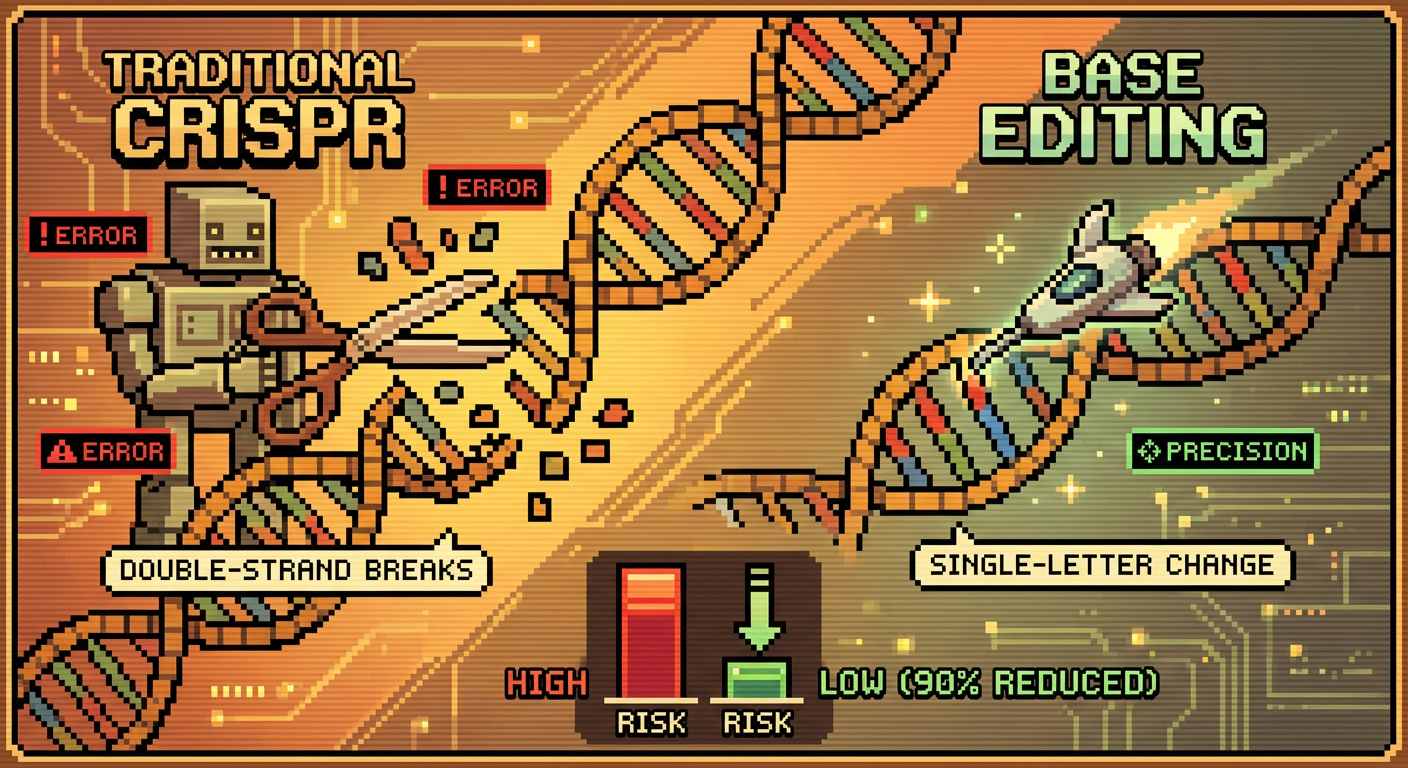
Let me establish the technical baseline, because it matters for understanding both the promise and the bottleneck. Traditional CRISPR-Cas9, the kind that made Jennifer Doudna and Emmanuelle Charpentier famous, works like molecular scissors. It cuts both strands of your DNA at a targeted location, then relies on your cell’s repair machinery to glue things back together. That process, while revolutionary, creates a window of vulnerability. Sometimes the cell’s repairs go slightly wrong. Sometimes the scissors cut at locations they were never meant to visit.
Base editing changes this calculus completely. Instead of cutting DNA, it converts one genetic letter into another with surgical precision. Think of traditional CRISPR as demolition followed by reconstruction. Base editing is more like find-and-replace in a word processor. According to research from the Broad Institute, this approach reduces off-target editing risk by approximately 90% compared to earlier methodologies. That is not a trivial improvement. That is the difference between a therapy that works reliably in 97% of people and something we’d be much more nervous about deploying broadly.
In sickle cell disease specifically, the mutation is simple: a single nucleotide change in the beta-globin gene. One letter. Base editing can fix that one letter without disturbing anything else in the genome. The cells then produce normal hemoglobin instead of the misshapen variant that causes the disease. Patients stop needing transfusions. They stop having pain crises. The disease, for practical purposes, goes away.
The FDA’s Accelerated Yes — and What It Actually Means
Beam Therapeutics received Breakthrough Therapy Designation from the FDA in mid-2024, which fast-tracked BEAM-101’s regulatory review pathway. This is significant, but not what casual headlines sometimes suggest. Breakthrough Designation does not mean the therapy is approved. It does not mean it’s available at your hospital next month. What it means is that the FDA has looked at the early data, found it compelling enough to warrant expedited review, and committed to moving faster through the normal approval process.
The designation reflects genuine confidence in the underlying science. When the FDA grants Breakthrough status, regulators are essentially saying: we believe this works, and we’re going to prioritize our review to get it to patients sooner. In the context of a disease like sickle cell, where patients have been waiting for better options for decades, this is meaningful progress. But it’s a beginning, not an endpoint.
Think of it as a runway that’s been shortened and prioritized, not a finish line that’s already been crossed. BEAM-101 still needs to complete its regulatory journey. The FDA still needs to formally review manufacturing details, long-term safety data, and real-world effectiveness monitoring protocols. None of this is bureaucratic theater. These are real questions that need real answers before a therapy gets integrated into standard medical practice.
The Scale Problem That Explains Everything
Here’s where things get genuinely complicated, and here’s what most coverage misses entirely. Let me use proportions to make this clear, because the numbers are almost incomprehensible in their disproportion.
Approximately 100,000 people in the United States have sickle cell disease. Globally, about 8 million people live with the condition. Sub-Saharan Africa accounts for roughly 75% of all newborn sickle cell cases annually. Now consider that the existing gene therapy approved in 2023, called Casgevy, carries a price tag of approximately $2.2 million per patient. Just one patient. One treatment. $2.2 million. When the World Health Organization issued an advisory in January 2025, they did not mince words about the access equity crisis this creates.
Now imagine scaling base editing therapy to even 1% of the global sickle cell population. That’s 80,000 patients times $2.2 million per patient. That’s 176 billion dollars. The manufacturing and distribution infrastructure does not currently exist to deliver this therapy at scale, even if we somehow magicked the financial component into existence. We would need new manufacturing facilities, trained technicians, regulatory frameworks in dozens of countries, and supply chain solutions that make pandemic vaccine distribution look straightforward by comparison.
This is not a problem with BEAM-101 specifically. It’s a systemic problem with cell and gene therapies as a class. They work at small scale. They fail at large scale. The medical community can treat dozens of people. We cannot, under current models, treat millions.
Why Your Doctor Cannot Prescribe This Yet
Let me be direct about what needs to happen before BEAM-101 reaches your local clinic. First, the FDA must complete its formal review and approve the therapy. This typically takes months, possibly longer, though Breakthrough Designation should accelerate the timeline. Second, the manufacturer must establish stable, reliable production processes capable of consistent output. Third, your hospital or clinic must receive training and certification to administer the therapy safely. Fourth, insurance companies and government health programs must negotiate pricing and coverage policies.
Then there are questions nobody talks about enough. How do we prioritize who gets treated first when demand vastly exceeds supply? Do we treat people sequentially, first-come-first-served? Do we establish clinical criteria? Do we prioritize children over adults? Do we reserve doses for patients with the most severe disease? These are not trivial questions. They’re ethical questions that medical systems are not yet equipped to answer systematically.
For patients outside the United States, the situation is even more constrained. Most countries lack the regulatory framework to rapidly evaluate and approve new gene therapies. Manufacturing will likely remain concentrated in a handful of developed nations. Logistics and cold chain management present additional barriers. The countries carrying the highest burden of sickle cell disease — nations in sub-Saharan Africa — have the fewest resources to absorb a $2.2 million-per-patient treatment.
What Actually Happens Next
I want to be careful about tone here. This is not a story of medical failure. BEAM-101 working in 97% of trial participants is genuinely remarkable. Base editing is a real scientific achievement with applications extending far beyond sickle cell disease. The people at Beam Therapeutics and the clinical teams running these trials have accomplished something real.
But it is a story about the vast gap between innovation and implementation. Between what we can do and what we actually do for patients at scale. Between a therapy that works and a therapy that reaches the people who need it most.
Here’s what I expect to happen: BEAM-101 will be approved. It will become available at major medical centers in wealthy countries. Several hundred patients per year will receive the treatment. News coverage will celebrate each approval milestone. And millions of people with sickle cell disease will continue managing their condition the way they have for decades, waiting for the day when base editing becomes something more than an achievement in a prestigious journal. The question is not whether the science works. The question is whether we can build the systems, the infrastructure, and the political will to make it work for everyone who needs it. That question remains genuinely open.