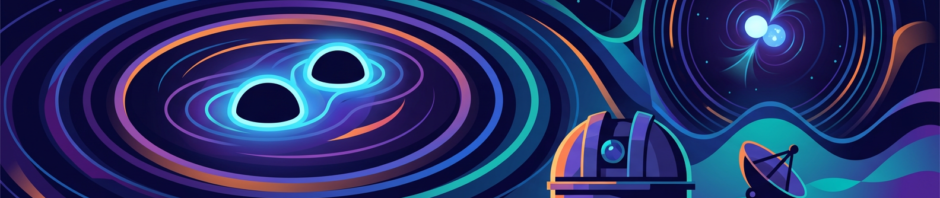
When Space-Time Ripples Like Water
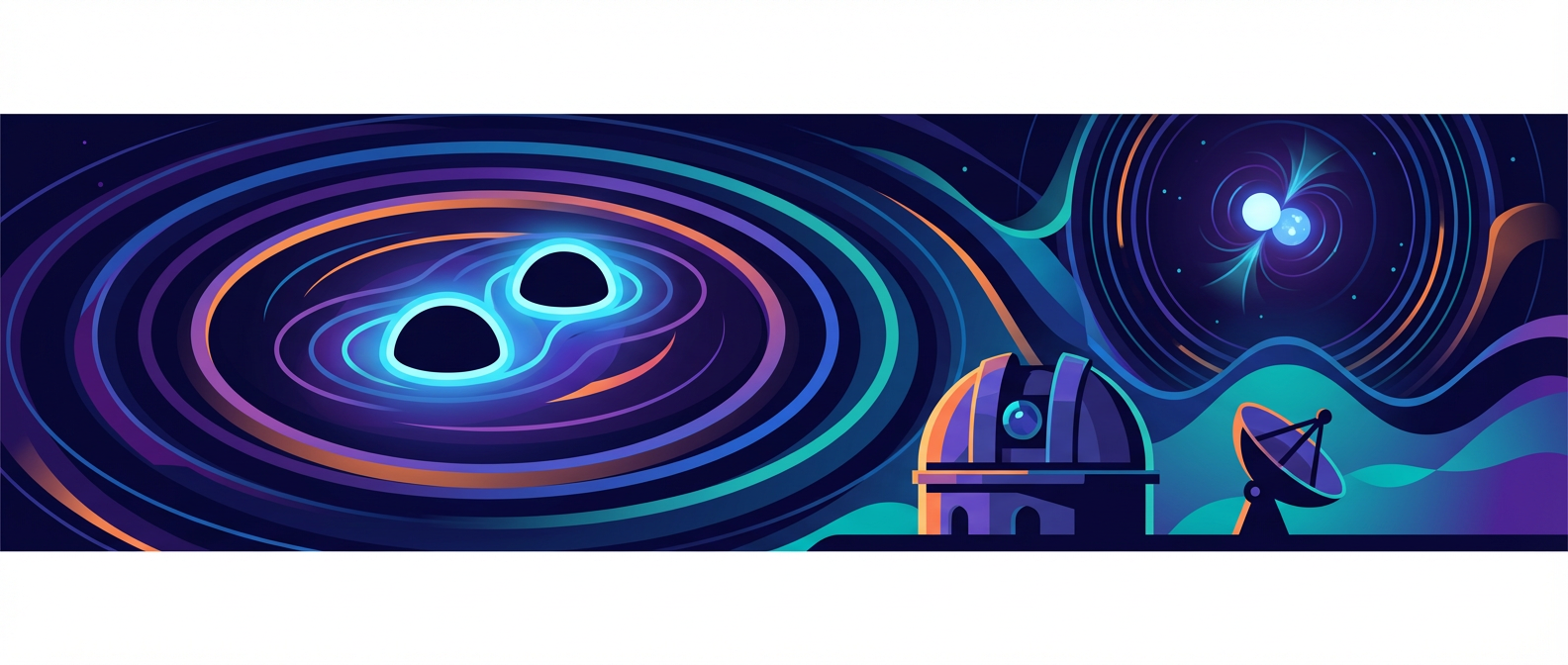
Picture this: 1.3 billion years ago, two black holes spiraled toward each other in a cosmic death dance, their immense gravitational fields warping space and time itself. In those final milliseconds before collision, they accelerated to half the speed of light, releasing more energy in gravitational waves than all the stars in the observable universe emit in light. Those ripples in the fabric of space-time traveled across the cosmos, growing weaker with distance, until on September 14, 2015, they gently squeezed and stretched a laser beam in Louisiana by less than 1/10,000th the width of a proton.
That impossibly tiny measurement changed everything. LIGO’s detection of gravitational waves didn’t just confirm Einstein’s century-old prediction, it opened an entirely new window into the universe. For the first time in human history, we could hear the cosmos singing. And what we’re learning from that song is completely changing how we understand black holes, neutron stars, and the basic nature of reality itself.
The Technology That Listens to the Cosmos
The Laser Interferometer Gravitational-Wave Observatory works like the most sensitive ruler ever built. Two perpendicular arms, each stretching 4 kilometers, house laser beams that bounce between mirrors suspended in ultra-high vacuum. When a gravitational wave passes through, it stretches one arm while compressing the other by distances smaller than a thousandth of a proton’s diameter. The precision required is mind-boggling. Imagine measuring the distance to the nearest star to within the width of a human hair.
This technological marvel took decades to develop. Engineers had to master laser physics, materials science, and vibration isolation. The mirrors must be protected from everything, from earthquakes to passing trucks, suspended by complex pendulum systems that filter out terrestrial noise. Even quantum fluctuations in the laser light itself create a fundamental limit to sensitivity, requiring sophisticated techniques to squeeze quantum states and push beyond classical measurement boundaries.
But LIGO isn’t working alone. The European Virgo detector in Italy and Japan’s KAGRA facility form a global network that can triangulate gravitational wave sources across the sky. When multiple detectors register the same signal within milliseconds of each other, we know we’re witnessing something cosmic, not just interference. This network approach has been crucial for pinpointing sources and coordinating follow-up observations with traditional telescopes.
Black Hole Mergers: The Universe’s Most Violent Events
Since that first detection, LIGO and its partners have cataloged dozens of black hole mergers. Each one is a unique cosmic catastrophe. These aren’t the stellar-mass black holes we thought we understood. Many are surprisingly massive, ranging from 20 to 100 times the mass of our sun. Some spin rapidly, others barely rotate at all, suggesting diverse formation pathways that theorists are still working to understand.
The most intriguing discovery may be the existence of an apparent “mass gap” in the black hole population. Between roughly 3 and 5 solar masses, we find almost no black holes. It’s a desert in the cosmic census that hints at the poorly understood physics of stellar collapse. When massive stars exhaust their nuclear fuel, something determines whether they form neutron stars or black holes. That boundary appears sharper than anyone expected.
These mergers also provide unprecedented tests of Einstein’s general relativity in the strongest gravitational fields in the universe. So far, Einstein’s equations describe every detection perfectly. This holds true even as black holes accelerate to relativistic speeds and generate gravitational fields billions of times stronger than anything we can create on Earth. Each confirmation strengthens our confidence in general relativity while simultaneously pushing us toward new questions about quantum gravity and the nature of space-time at the smallest scales.
Neutron Star Collisions: Cosmic Alchemy in Action
On August 17, 2017, gravitational wave astronomy entered a new era with the detection of merging neutron stars. Unlike black hole mergers, this event, designated GW170817, produced electromagnetic radiation visible to traditional telescopes. Within hours, observatories worldwide were tracking the explosion across the spectrum, from radio waves to gamma rays.
What they found was cosmic alchemy in action. The collision created a kilonova, an explosion that forged roughly 200 Earth masses worth of gold, platinum, and other heavy elements. The characteristic signatures in the optical spectrum confirmed decades-old theories about how elements heavier than iron are created in the universe. Every gold atom in your jewelry, every platinum catalyst in your car, was likely forged in such a collision billions of years ago.
The neutron star merger also provided the first direct measurement of the Hubble constant using gravitational waves. This is a completely independent method for determining how fast the universe is expanding. This “standard siren” approach could help resolve ongoing tensions between different measurements of cosmic expansion, potentially pointing toward new physics beyond our current standard model of cosmology.
What’s Coming Next: The Future of Gravitational Wave Science
The current generation of detectors is just the beginning. LIGO is undergoing upgrades to improve sensitivity by another factor of two. Next-generation facilities like the Einstein Telescope and Cosmic Explorer promise to detect gravitational waves from the edge of the observable universe. Space-based detectors like LISA will open entirely new frequency ranges, sensitive to supermassive black hole mergers and possibly primordial gravitational waves from the Big Bang itself.
These improvements aren’t just incremental. They’re transformational. Better sensitivity means detecting fainter sources, which translates to observing events at greater distances and earlier cosmic times. We may soon detect the first black holes that formed after the Big Bang, witness the merger of supermassive black holes at the centers of galaxies, or even observe gravitational waves from cosmic strings or other exotic phenomena predicted by theories beyond the standard model.
The combination of gravitational wave astronomy with traditional electromagnetic observations is creating a new field called multi-messenger astronomy. When we can simultaneously observe cosmic events through both gravitational waves and light, we gain insights impossible with either method alone. Future networks of gravitational wave detectors will provide precise sky localization, enabling rapid follow-up observations and comprehensive studies of cosmic phenomena.
We’re living through the birth of an entirely new field of astronomy. One that lets us probe the universe’s most extreme environments and fundamental physics in ways that were pure science fiction just decades ago. Each detection brings new surprises, challenging our theories and expanding our cosmic perspective. The universe has been singing for billions of years. We’ve only just learned how to listen.